Alleluia Cone’s oxygen-free summit of Everest
The Satanic VersesAlleluia Cone’s oxygen-free ascent of Everest with Pemba is both a mountaineering feat and an encounter whose meaning she cannot settle. Recounted to a school class, the climb moves from a deliberate rejection of breathing equipment into visions of Angels and an inexplicable report that breaks the summit’s spell. Its aftermath keeps the achievement open-ended: the mountain remains an object of longing, but also a source of danger, uncertain memory, and apparitions that resist ordinary explanation.
Before the Ascent
Alleluia Cone had concealed a worsening footache from her fellow mountaineers because Everest’s pull was stronger than her wish to acknowledge the pain. She understood the congenital weakness in her foot as a kind of restraint, and imagined that her adventure might end through the very part of her body that had to carry her. The image of footbinding came to mind; the thought also echoed Maurice Wilson’s ghost, whose presence would recur in her account of the mountain. Her ambition was not uncomplicated confidence: she knew her body could fail her, yet continued toward the summit.
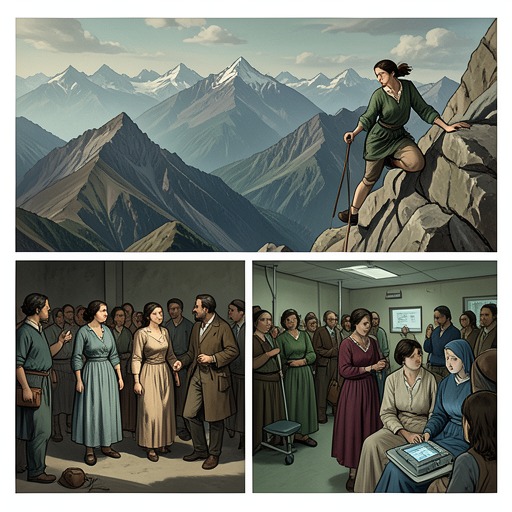
Years later, in a classroom, the girls pressed her for the story of the climb. They wanted not an account of phantoms but the experience of reaching the mountain’s top. Alleluia Cone described herself as part of the second pair, with Pemba, after the first pair had gone ahead. The weather was exceptionally clear, and conditions seemed to allow them to continue. She had not planned to climb without oxygen. The decision changed when she saw that Pemba intended to do so. She chose to follow, aware that the impulse was unprofessional, and wanted to meet the mountain as a person rather than as a breathing machine.
Pemba warned her against the choice, but she started up. He had never reached the summit either, and on the ascent his usual clowning gave way to seriousness. The decision was therefore not a routine extension of a settled plan: two climbers faced the summit without oxygen, and Alleluia Cone committed herself to that risk after seeing her companion do the same. The climb brought her ambition into direct contact with physical limits, the tension that gives her later account its force.
The Summit and Its Visions
On the way up, the pair passed climbers descending from higher ground. Their exhilaration was so pronounced that they did not notice Alleluia Cone lacked oxygen equipment. They called out a warning about Angels. Pemba found a steady breathing rhythm, and she matched it, breathing in and out with him. She remembered a sensation of something lifting from the top of her head and the two climbers grinning together. What might have looked like strain was, in her account, joy.
The summit transformed exertion into a moment she described to her pupils as spiritual transcendence. Looking down across the Himalayas, she experienced the view as the face of God and believed, then, in the possibility of perceiving the universe’s sound and lifting a veil. She recalled floating over the final overhang and arriving where the ground fell away on every side. Light seemed to purify the universe; she wanted to expose herself to it. The children listening to the story followed her imaginatively onto the summit, while the narrative itself held physical labor and visionary certainty together: the experience was reached by hauling herself up an icebound height.
Rainbows appeared to loop across the sky, and radiance seemed to pour down from the sun. Alleluia Cone saw Angels, and believed Pemba saw them too. They went down on their knees; she remembered his pupils as pure white, as she believed her own might have been. She later judged that they might have died there, blinded by snow and impaired by the altitude, had nothing interrupted the vision. The summit’s exaltation was not a safe refuge but a condition in which the climbers could lose the capacity to protect themselves.
The Report and the Descent
A loud, sharp report, like a gunshot, abruptly broke the visionary episode. Alleluia Cone shouted to Pemba, who shook himself out of the same state, and they began descending. The weather was changing quickly, with a blizzard approaching; the lightness she had experienced gave way to a sense of heaviness. The four climbers reached their meeting point and crowded into the small tent at Camp Six, at twenty-seven thousand feet. There, she asked whether anyone had fired a gun.
The others dismissed the possibility: they said there was no gun on the mountain and that firing one at that altitude would make no sense. Alleluia Cone accepted that they were right about the absence of a weapon, but remained certain she had heard the sound. In the classroom, she ended her story without explaining it. When the girls insisted on an answer, she could offer only the possibility that it had been Maurice Wilson’s ghost. The unexplained report thus marks both a practical reversal—from summit vision to urgent descent—and a lasting gap in her account. It is not resolved into a confirmed supernatural cause or a physical explanation.
Aftermath and the Mountain’s Hold
The climb’s consequences were not limited to that night at Camp Six. Alleluia Cone later experienced lapses in memory: she forgot the word for fish at a fishmonger’s, could not immediately identify the purpose of a toothbrush, and briefly failed to recognize Gibreel Farishta when she woke beside him. She hoped the lapses would be temporary. She also kept from him her continuing sightings of Maurice Wilson’s ghost on rooftops around the Fields, where the ghost appeared to beckon. These details complicate any account of the ascent as an uncomplicated triumph: she believed will had carried her beyond limits, but she also acknowledged damage and uncertainty afterward.
On the descent from Everest, she saw what seemed to be a city of ice beyond the Rock Band, across from the massif of Cho Oyu. For a moment she thought of Shangri-La, then saw not a green valley but a vast formation of sharp ice needles. Pemba called her attention back to the climb; when she looked again, the city had disappeared. The apparition brought her mind to her father Otto Cone’s warning that the world was not a homogeneous whole in which every element could be reconciled. In the memory attached to the vision, incompatible realities—ghosts, saints, and horrors—could occupy the same world. The mountain’s impossible city became an image of that coexistence rather than an explanation of it.
Back in London, Alleluia Cone told Gibreel Farishta about the Everest visions and the ice city. She described another apparition from an early-morning walk by the Embankment: ten icebergs moving upriver in a line, shaped like the ten highest mountains, with Everest at the end. Mist hid them and then dispersed, taking them from sight. Gibreel did not dispute her account. At home, representations of the Himalayas filled her apartment, including a small Everest carved from weathered pine that Pemba had given her on behalf of the Sherpas. Its carefully carved route included the ice fall and Hillary Step; on its underside was a message warning her not to try again. She did not tell Gibreel how deeply that warning frightened her, or how prohibition intensified her longing to return.
Alleluia Cone explained her survival without oxygen as a matter of will and anger, forces she believed scientific calculations could not quantify, though she also cautioned against pushing one’s luck. The ascent therefore leaves neither a simple proof of human mastery nor a settled account of supernatural revelation. It joins discipline and reckless choice, bodily effort and altered perception, the desire to ascend and the knowledge that the mountain may exact a lasting price.